
quick dashed-off notes
come to an AFTER ALL THIS screening and reading next week 2/4

I used to find my office, a small doleful room with uneven walls and floors, very ugly. Then I painted it a shade somewhere between burgundy and stewed raspberries and it became beautiful to me. It’s that particular quality of alteration I’ve been thinking about: first one state, then another. The question that only some people ask and hold: what could make this work? What could rescue this, what could make this more bearable, what could make this more beautiful?
Everyone I know has been living through real change. One state, then another, for some; for some an in-between—a primed-not-painted room. Yesterday I saw an old friend, a naturalized American citizen, who told me about his experience being racially profiled by ICE while in the Midwest last year, flung against the Uber he was ordered out of and handcuffed while he was screaming. The longer story he told me was a human one, one the novelist would be interested by, more than the journalist. A story, in short of what can happen after, at the human scale, happen after something like that, to someone’s life and relationships and sense of future.
It is difficult to convey how much work and time naturalization takes in the U.S., how difficult-to-impossible it can be to qualify for and attain citizenship.
My friend told me last night he has begun to make plans to leave this country.
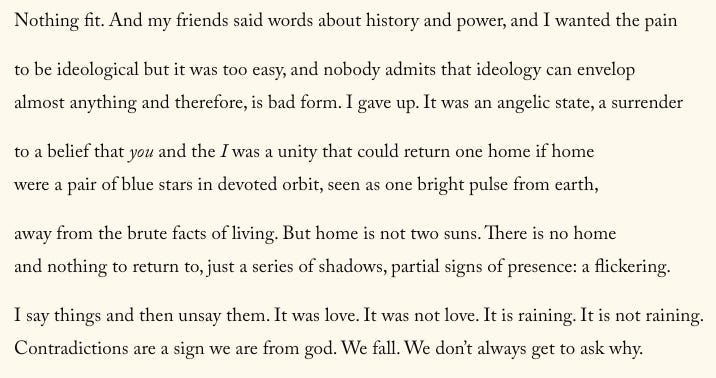
Things can change in a day. It’s a line repeated throughout Arundhati Roy’s The God of Small Things, a refrain that is factual and ominous at once, foreshadowing the novel’s malayali gothic turns. On my desk in my stewed-raspberry room is a small framed gift from my friend Meg, an excerpt from her poem Drive, with the lines: I say things and then unsay them. It was love./ It was not love. It is raining. It is not raining. / Contradictions are a sign we are from god / We fall. We don’t always get to ask why.
wednesday 2/4 screening of andrew nadkarni’s after all this and a reading from my manuscript in the desert
If you’re in NYC this coming Wednesday, come to this event that the Asian American Writers Workshop is putting on! Andrew Nadkarni, Maryam Mir, and I will talk about making sophomore work; we’ll screen their gorgeous short film After All This and I’ll read from The B**k. 🧿 More about After All This here:

This part, in particular, still feels true:
My heart was thudding as the title appeared. It’s not not vulnerable, for someone constructed the way I am, to let strangers into a glimpse of my life, into something in-progress, versus finished fiction work. But I watched and something eased in me. I saw what someone else had made from material that involved me, from the work of many hands. I saw footage for the first time of myself as a child, intrigued and made self-conscious by the total novelty of being recorded. I saw glimpses of my many places, present and lost and fleeting. I saw myself as an adult and an artist, trying to make work, speaking about its challenge and interest.
And as I stared up at the screen I felt the passage of time, the sense that I had been captured in a moment of it, in becoming, in the making—of myself and my work. Time, which makes everything okay, and also doesn’t, which traps and frees us all in its relentless melt of becoming and loss.
to being more outside of late, writing as hostility vs writing as seduction
After a long and strange—let’s call it, for now, hibernation—I started putting more new work out in the world again last fall and will continue to this year, if God wills it. Here’s me reading a new short story (featuring cows, ships, a post-U.S. setting, a glamorous and withholding Malayali grandmother) at Metropolitan Bar earlier in the month. This was part of Ariél Martinez’ delightful reading series Perfume.
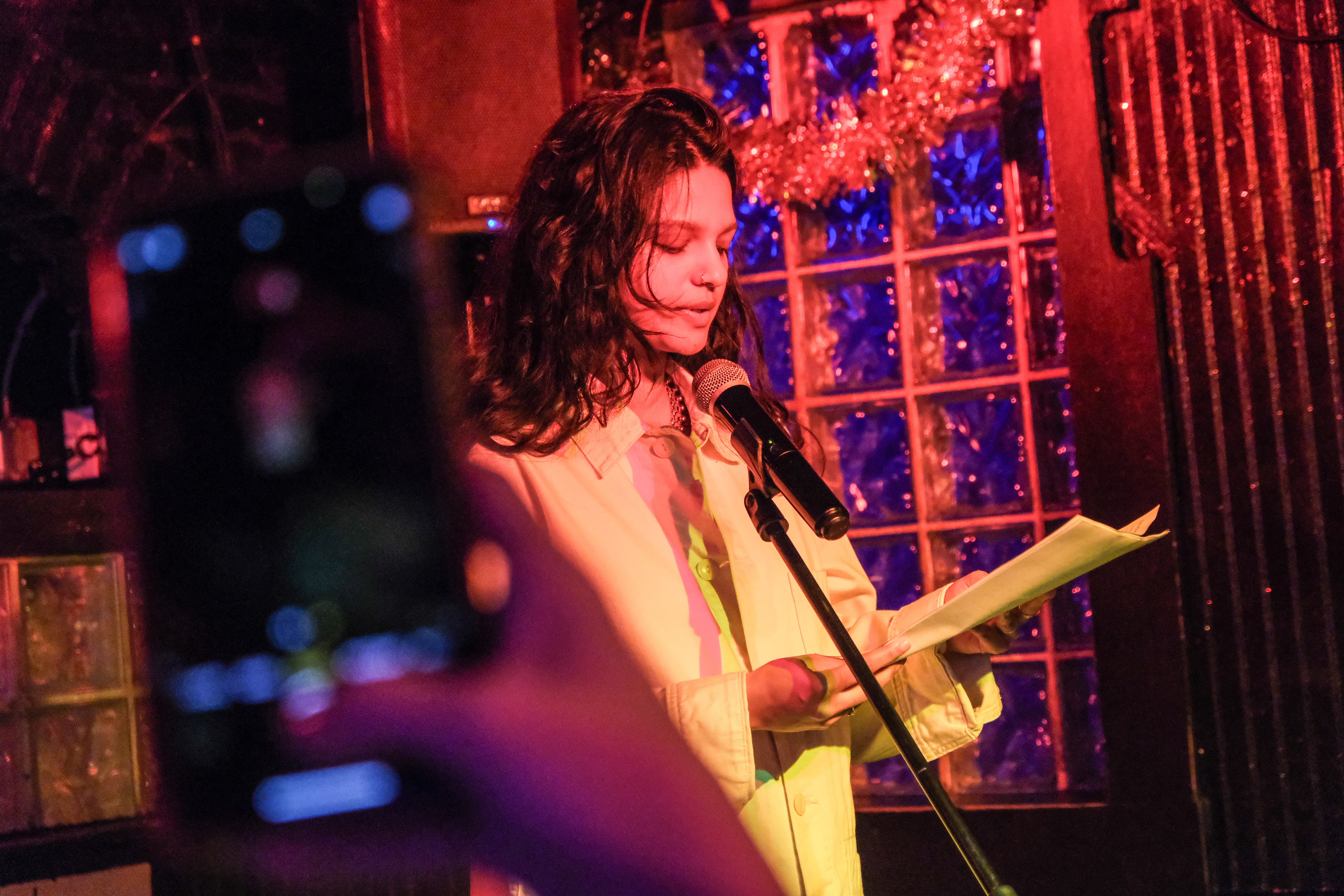
Like my recent readings at Gate of the Sun and Doom Sanctuary fall of 2025, there was a performance slash participatory aspect to my Perfume reading. There are a variety of reasons why I’ve been doing this of late; some are loftier than others, more grounded in principle. But one less-lofty one is simply this: my own attention is hard to command, and so I know this is true of others. And I want your attention. Not for me as self, or person—truly and actually—but for the work. I want the reader’s presence, want the crowd’s. I’m willing to work for it.
Joan Didion often called writing a hostile act. Linda Kuehl once asked her to elaborate during an interview. She replied:
It's hostile in that you're trying to make somebody see something the way you see it, trying to impose your idea, your picture. It's hostile to try to wrench around someone else's mind that way. Quite often you want to tell somebody your dream, your nightmare. Well, nobody wants to hear about someone else's dream, good or bad; nobody wants to walk around with it. The writer is always tricking the reader into listening to the dream.
I agree with this wholly, but I’m not sure I experience this through the lens of an antagonism. I once talked to the writer Ayad Akhtar, who said some of the smartest things about All This Could Be Different I’ve ever had the pleasure of hearing; I said something I felt to be true across his work and mine and that of many of the writers I enjoy most was the attempt to seduce the reader. The act of seduction is informed by the zillion other claims being made every minute for the reader’s attention. And also, maybe, by the narrative’s disposition, hell, maybe the author’s as well—where the worst possible outcome is indifference and emotional disconnection and boredom. Come over here, the work says, or tries to. I’ll make it worth your while.
preorder living, together
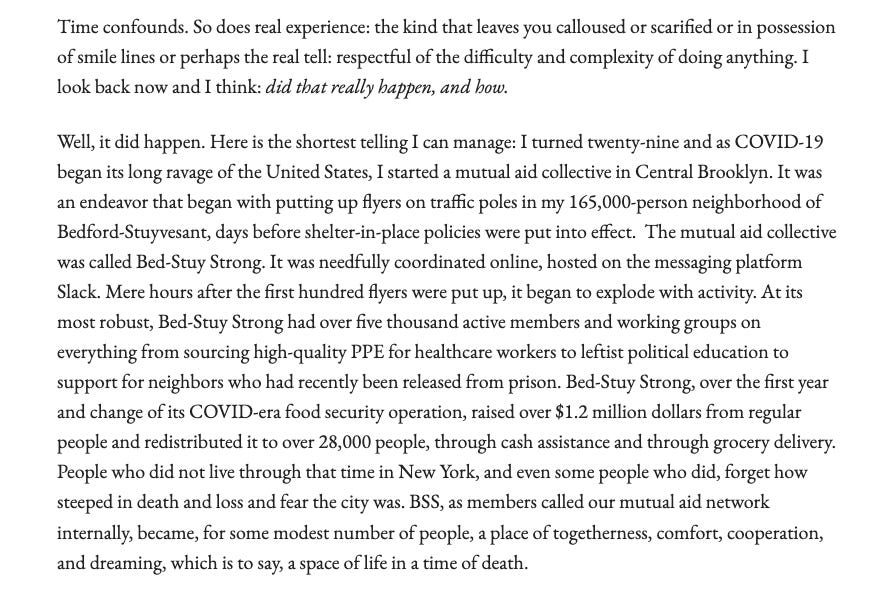
The writer and editor Samantha Paige Rosen has put together an anthology / labor of love called Living, Together. The binding theme is the attempt to find and make community in an age of disconnection. It features essays from Kim Stanley Robinson, Jonathan Escoffery, Kristin Arnett, Rhaina Cohen, and other really great and smart writers. I’m excited to read what they have to say.
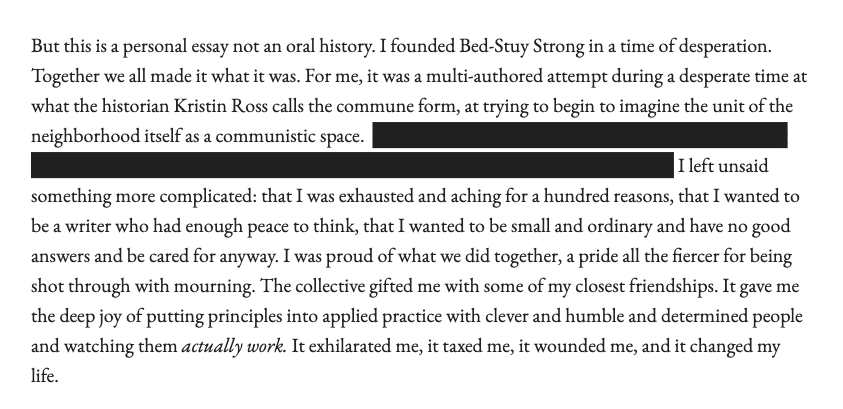
I have an essay in there too. It’s titled The Opposite of Loneliness. It’s a telling of some of my experiences organizing in Brooklyn during the height of COVID. I almost never write about the details of my organizing projects in public. This is one departure.
american occupation is boomeranging into american cities, one by one
Since I last wrote referencing events in Minnesota, the occupation has worsened, grown more brutal. I’m not going to say so much here this time around, partly because I know from experience that endless exposure to terrible things and bad news makes most people feel afraid and paralyzed and helpless. You can in fact do something tangible, perhaps with people you like and trust, to be in solidarity with people who live in Minnesota who are being terrorized. Today is a national day of protest and striking against ICE. You can find the ones close to you. NYC’s protest is today, 4 PM, Foley Square. If you can go without your smartphone, that’s what I might do.
I don’t experience myself as particularly radical. I am a student of people, or I try to be. People can change things. In themselves. In the rooms of their own lives. In the way the structures that govern their lives are organized. The change is often flawed and partial, compromised and volatile. But things can change. The future is unknown and unknowable. Give yourself to it.
Love,
Sarah
I'd love to know when the Living, Together anthology becomes available in the UK. It reminds me of this story by Naomi Kritzer: https://www.uncannymagazine.com/article/the-year-without-sunshine/ I feel we need all the information and inspiration we can get about mutual aid and self-organisation.
Funny, I don't think of it as antagonism or seduction, more like if someone is hovering on your doorstep and you open the door and say come on in, look at this weird vase I picked up off the sidewalk, try this sandwich where I invented a new kind of sauce by mixing together all the kinds of sauce I could find.