
year's end
on resolution and practice

There’s a poem I dig by Dana Gioia called New Year’s and it begins,
Let other mornings honor the miraculous.
Eternity has festivals enough.
This is the feast of our mortality,
The most mundane and human holiday.
I don’t care deeply about New Year’s Eve. This was a posture maintained for years out of necessity. Teens to mid-twenties, I’d spend NYE with my parents, usually flying back to the city I lived the morning of the first.
Because I adaptively appear both entirely assimilated to the U.S. and like someone who rarely lets people order me around, people seem surprised when I say things like, “I wasn’t allowed to leave the house without permission, or after a certain hour.” Just immigrant tings, it’s not that deep to me. New Year’s Eve, for those years, was watching Netflix with my sister, was enforcedly sedate. There was one night where I snuck out through a window, landed in the snow-caked husk of a mint bush and then went to a truly terrible club, but we digress.
Anyway, for the past few years I’ve gone to NYE parties or escapes-from-the-city, and they’ve been pretty lovely. My friend Rebeca, who is from northern Spain, has brought our friend group her tradition, las doce uvas de la suerte. The twelve grapes of luck. To close out Nochevieja you eat twelve grapes—for good fortune and prosperity—all in the single minute before midnight. It’s a bit of a choking hazard, but also very fun. Adds some texture to the usual countdown-and-then-coupled-people-kiss deal.
My personal feeling, though, is that new year’s day is where it’s at. And in general I have been trying to put my feelings — ephemeral wispy inchoate things that pass through and over me — into practice. Which is to say, into doing, into something embodied, into something tangible.
On Jan 1st each year, I wish my grandmother in India for her birthday, I eat something delicious, I write down my intentions (more on that in a minute), I try to keep my heart peaceful and clean, and most of all, I try to spend some time near water. For the last few years, I’ve bundled up and driven with a couple loved ones to walk by the ocean—Riis, Tilden, Jones Beach—on the first day of the new year.
There’s something about water, the life and death and formlessness it holds, that I want to return to on occasions of beginning or end, and each new year’s day is both. Let other mornings honor the miraculous.
quick intermission for book stuff
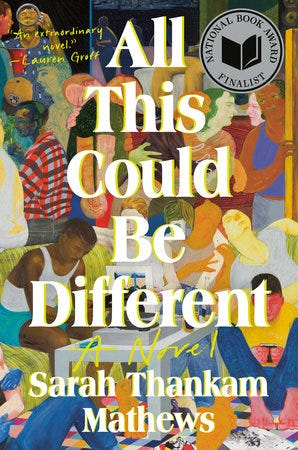
All This Could Be Different has a sexy new silver sticker on the front that says NATIONAL BOOK AWARD FINALIST. For everyone who has asked or wondered after hearing about the award gala, Padma Lakshmi is indeed that hot IRL. ATCBD was named one of the top 5 books of the year by the Los Angeles Times and TIME magazine and one of the Best Books of 2022 by NPR, Vogue, Vulture, BuzzFeed, Slate, Harper’s Bazaar, and more. (!!!) If you’d like to get it as a present (pick your retailer of choice, indie bookstores always best for the future of publishing imo) for someone you love or like, or read it with your book club, I’d love that so much. I’ve been doing less press stuff as I work on my 𝓷𝓮𝔁𝓽 𝓫𝓸𝓸𝓴, but I did get to talk to Melissa Harris-Perry for WNYC’s The Takeaway and that was very cool.
The most common observed ritual—alongside the hangover—on new year’s day is the writing of resolutions for the year to come.
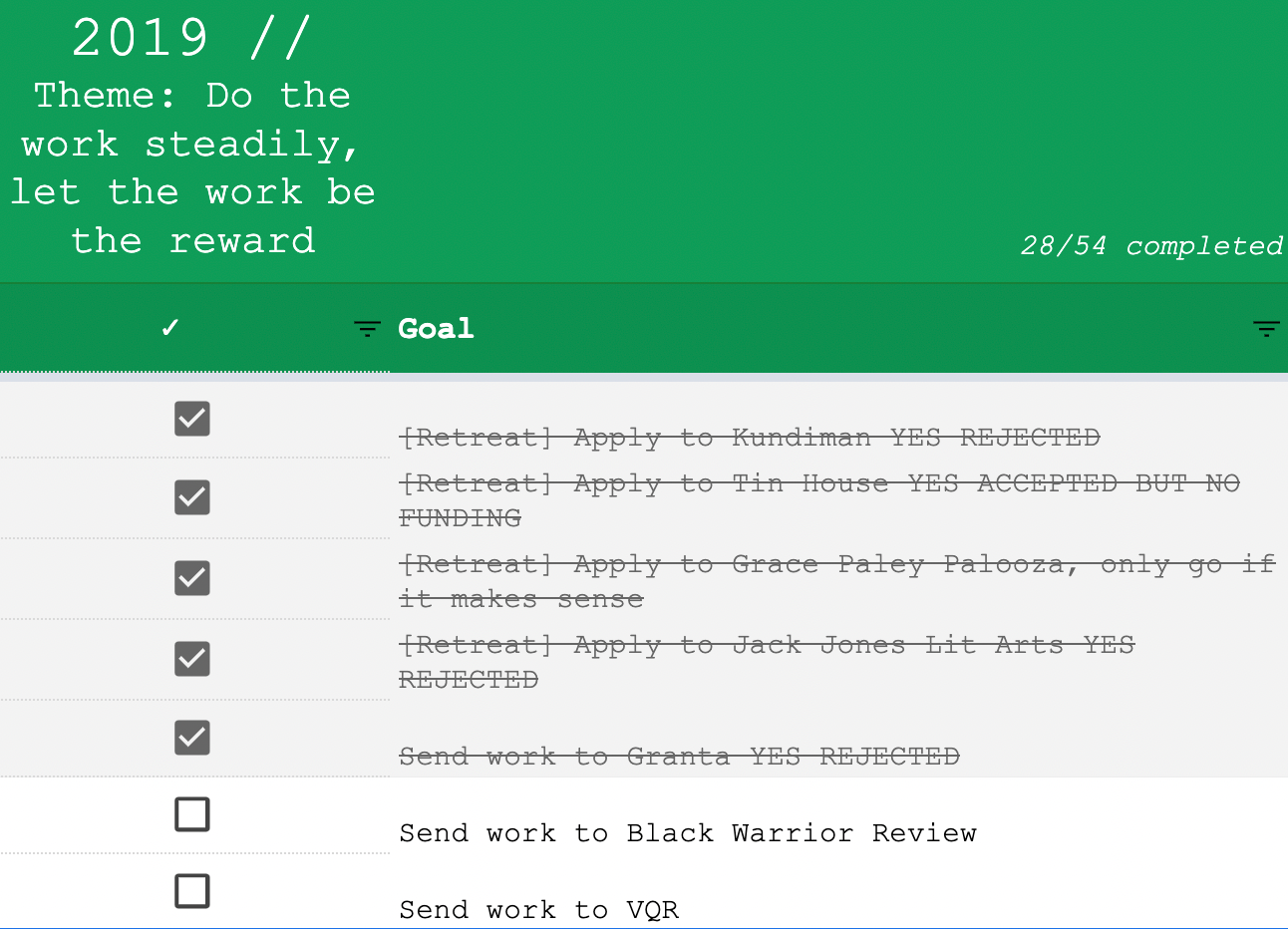
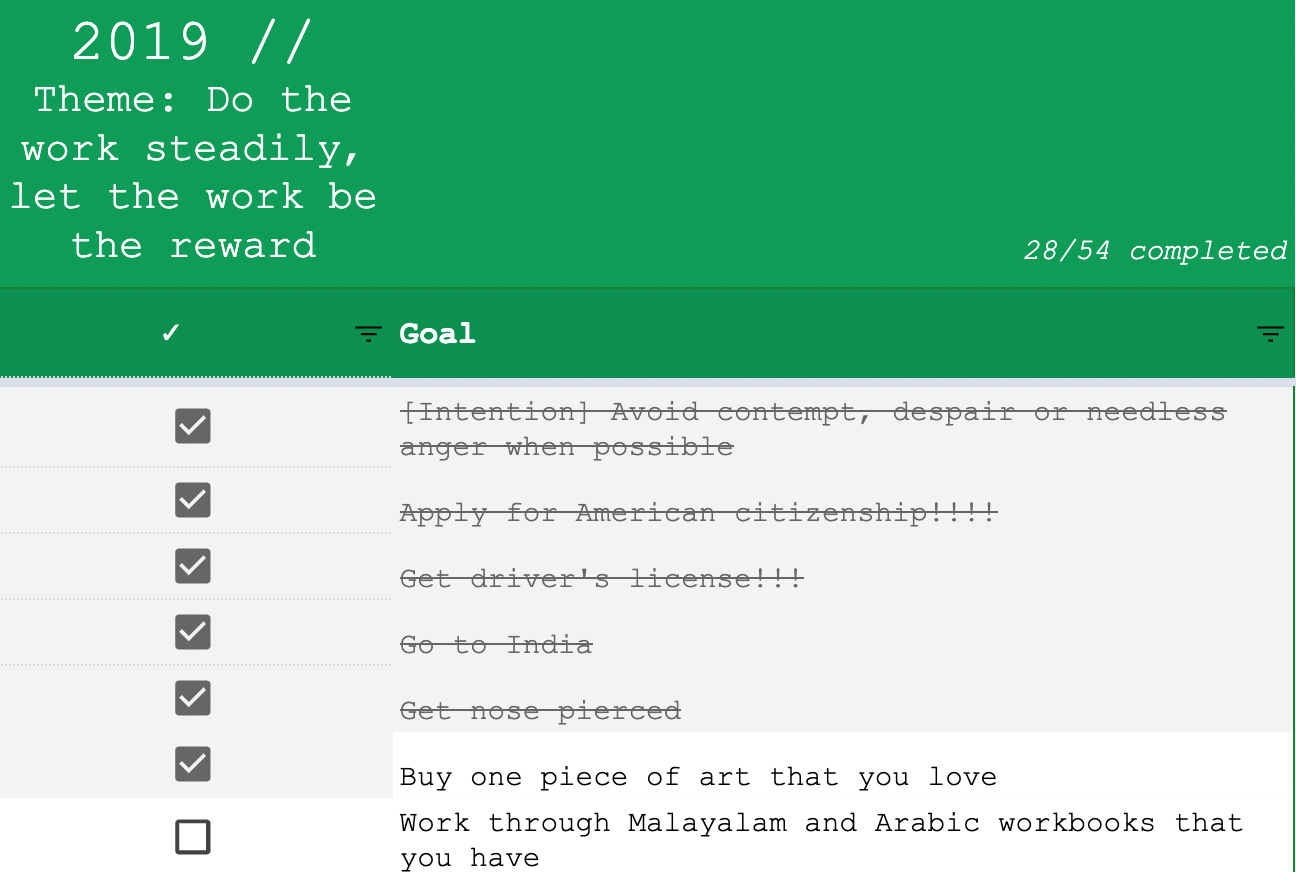
I’ve developed my own customs around this stuff: writing longhand and then transposing a list to a spreadsheet, opting for having more resolutions than I think I will reasonably get to, with the idea that it is good to simultaneously aim high and embrace failure.
To be clear, I don’t have any prescriptions for people around this: you gotta figure out what you want, and there are as many arguments for not doing new year’s resolutions as there are for doing them.
What topped my 2019 reso list was the same thing that began every list for the four years before it. Finish your damn book. I got to it eventually, in 2020, with an entirely different novel. I wrote about that here, if you’re new to the pudding.
At some mitochondrial level I’m bad at habits, bad at commitment, bad at consistency, and so succeeding at any of these requires meaningful work for me, though it’s work I’m willing to put in. For so long, in the stead of habits, I’ve had a projects-based attitude toward almost everything: organizing, actions, books-in-progress, friend capers. When I’m in a project, really in flow with it, it feels like good drugs, it feels like my brain at its best and most powerful. What I’m running into now, though, is that what I feel longing or aspiration around is rarely only a question of discrete / concrete things that I want to do, versus how I want to a) feel and b) be. This coming year, alongside the tangible tasks and projects, I want to make space for a few complex questions: about my writing, relational life, horizon-setting, and desires for myself. And I want to approach the question of how I celebrate milestones or occasions more by asking, first, how I want it to feel.
“But I did know that nobody ever asked me what I wanted for Christmas. Had any adult with the power to fulfill my desires taken me seriously and asked me what I wanted, they would have known that I did not want to have anything to own, or to possess any object. I wanted rather to feel something on Christmas day. The real question would have been, “Dear Claudia, what experience would you like on Christmas?” I could have spoken up, “I want to sit on the low stool in Big Mama’s kitchen with my lap full of lilacs and listen to Big Papa play his violin for me alone.” The lowness of the stool made for my body, the security and warmth of Big Mama’s kitchen, the smell of the lilacs, the sound of the music, and, since it would be good to have all of my senses engaged, the taste of a peach, perhaps, afterward.”
- Toni Morrison, THE BLUEST EYE
The trouble for me is that making that sort of space—around feeling, being, asking— is far less straightforward than a checkboxed, get-her-done task list.
On a recent trip to Minneapolis, I read part of this equal-parts-dry-and-interesting book on Christian liturgy in the East versus West. I was captivated by this passage:
Worship and liturgy are sometimes described as the outward form of a religion, the "expression" of inner religious feeling. This description is partly right: faith and the experience of faith call for expression, for visibility and audibility in words and signs. Faith is outwardly witnessed in certain concrete ritual actions in a rite. But in our western practice faith has been so interiorized, so spiritualized that the external expression has become less important. Human thought grew accustomed to the division between body and soul, between external and internal, and, in the hierarchy of values, the body and the external stood lower by definition. This meant that the external form, the rite, was seen as inferior: it would have been thought ideal if the external was not even necessary. Let there be no doubt about it: the following pages are written from the conviction that there must be a connection between faith and its expression in language and sign, and that the human person is a spirited bodiliness who expresses that spirit in bodily words and deeds. In ritual, what is interior to the community becomes visible, audible, and palpable.
(A spirited bodiliness! Maybe I’m less a materialist than I once thought—)
A guiding question or abstracted desire, I decided, can also be expressed as a practice, as series of concrete actions, as a rite. The challenge at hand, then, is really about creating a container that can hold and work through something diffuse and complicated—which as an aside is not dissimilar from the challenge of making a novel. The questions at the heart of All This Could Be Different were, arguably, about homes and cultural scripts: how we receive them, navigate them, break them, and find our way.
And then I realized that my year-after-year goal set of write novel and finish novel and finish your damn novel please ended up creating, if inadvertently, a years-long practice. I thought writing the book I wanted to write would take me less than 365 days—and that’s a key mistake many of us make, misapprehending the unit of time in we should measure the distance to our desire. But for over six years, I tried to arrive at this goal, and my reward was not the novel I thought I would write and send out into the world, but simply, the ability to write itself. A greater understanding of what fiction can and can’t do. A cannier sense of what I can and can’t do well within it.
There are years that ask questions, Zora Hurston once said, and years that answer. For me, this last year answered. It offered, also, the mix of disorientation and peace that can follow any manner of conclusion. Shit, I’m grateful for all of it. That’s what I want to say by the water tomorrow: thank you for my life.
On this most mundane and human holiday, whatever the shape of your year and your desire for what’s next, know that I’m wishing you well.
If you do get grapes, go with the smaller ones.
xx
STM
hiya! came back to this post over a year later lol, and curious--do you recall the name of the book you mention in this post on Christian liturgy in the East v West? (sorry if you mentioned this elsewhere and I missed it!!)
I loved reading this fresh into the new year. Just wrote a bunch about how i want to Feel this year as a guiding force for what i want to do, what i always am doing (finish the damn book). Happy 2023 Sarah 🖤